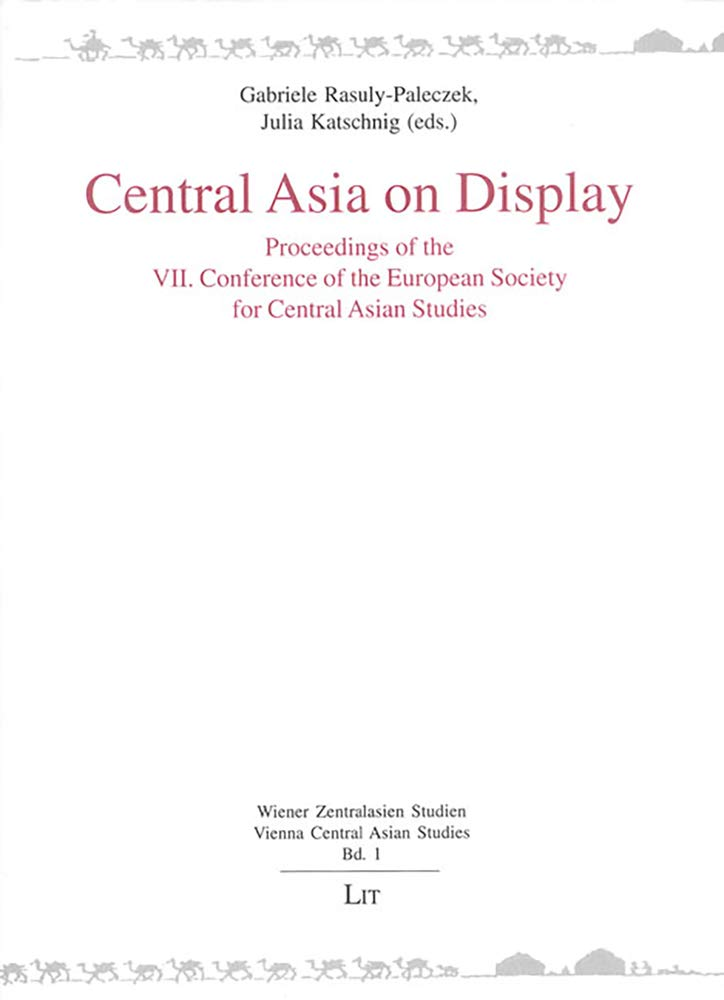
Gabriele Rasuly-Paleczek, Julia Katschnig (eds.)
Central Asia: Past, Present and Future
Vienna 2000
Despite its current geostrategic importance and its easier accessibility since the dissolvement of the Soviet Union, Central Asia has nevertheless remained a white spot on the map of western scholarship and public awareness.
Bringing together papers presented at the VIIth Conference of the European Society for Central Asian Studies, which took place in September 2000 in Vienna, this volume aims to shed light on the historical, political, cultural and socio-economic development of the region.
Scholars from within and outside Central Asia discuss a wide range of topics. By employing an interdisciplinary exchange of recent research results the two volumes offer an excellent insight into the current state of the art of Central Asian studies. At the same this publication allows a better understanding of the reconfigurations and ruptures associated with the current transformation processes in Central Asia, which, however, are embedded in a long-standing history of cultural and economic exchanges.
Among the topics highlighted in two volumes are contributions focusing on such issues as state formation and national building, literary traditions, music, arts, sports and games questions of identity formation, religious beliefs and practices, forms of social and economic organization, human rights, democratization, local and global politics.
Mag. Julia Katschnig studied Social Anthropology, Journalism, Spanish and French at the University of Vienna.
Asst. Prof.Mag.Dr. Gabriele Rasuly-Paleczek received an MA in Sociology and Political Sciences and a Ph.D. in Social Anthropology, Turkology and Islamic Studies from the University of Vienna. Currently she acts as the chair person of ESCAS.
Gabriele Rasuly-Paleczek, Julia Katschnig (eds.)
Central Asia on Display.
Proceedings of the VII. Conference of the European Society for Central Asian Studies
(Reihe: Wiener Zentralasien Studien – Vienna Central Asian Studies)
Vol. 1
Vienna 2004 (LIT-Verlag), 480 pages; 49.90 EUR, br.,
ISBN 3-8258-8309-4
Gabriele Rasuly-Paleczek, Julia Katschnig (eds.)
Central Asia on Display.
Proceedings of the VII. Conference of the European Society for Central Asian Studies
(Reihe: Wiener Zentralasien Studien – Vienna Central Asian Studies)
Vol. 2
Vienna 2005 (LIT-Verlag), 240 pages; 49.90 EUR, br.,
ISBN 3-8258-8586-4
Publisher´s address in Vienna:
Richard Kisling
LIT Verlag
Krotenthallergasse 10/8
A – 1080 Vienna, Austria
Tel.: 0043 1 40 95 661
Fax: 0043 1 40 95 697
LIT-VERLAG
(main representation of publisher)
Dr. Wilhelm Hopf
Grevener Straße
D-48 159 Münster
Germany
Tel: 0251 – 23 50 91
Fax: 0251 – 23 1972
Email: hopf@lit-verlag.de
Sales Representative in North-America
Transaction Publishers
390 Campus Drive
Somerset, NJ 07830
USA
Phone: Call toll-free (US only) 888-999-6778
Fax: 732-748-9801
Email: orders@transactionpub.com
Central Asia on Display
Proceedings of the VII ESCAS Conference
Editors: Gabriele Rasuly-Paleczek and Julia Katschnig
Volume I
“Geleitwort”
Dr. Benita Ferrero-Waldner
Table of Content
Introduction
Gabriele Rasuly-Paleczek and Julia Katschnig
Opening Speech of the Conference
Dr. Benita Ferrero-Waldner
Chapter I: Processes of State Formation and Nation Building in Central Asia
Balancing ‘Yasa’ and ‘Shariat’ in the Shibanid-Uzbek Khanate in the 16th Century. Nurten Kilic-Schubel
The Emirate of Buhkara in the 19th and 20th Century: Reflections on Transition. Suchandana Chatterjee
The Problem of Political Order in the Khanate of Khokand: Between Tribalism and Patrimonialism. Paul Georg Geiss
The Evolution of the Traditional Governing Elites of Kazakhstan within the Russian Empire between the Middle of the 18th and the Beginning of the 20th Centuries. Irina Erofeeva
Frontiers, Hinterlands, Centers, Peripheries: Adapting to Changing Fortunes – the Uzbeks of Afghanistan. Gabriele Rasuly-Paleczek
Who was Ibrahim Bik? Reinhard Eisener
Enlightening the People: The Practice of Modernity in Central Asia and its Trans-Caspian Dependencies. Touraj Atabaki
History in Uzbekistan (1989-1999). Azim M. Malikov
Chapter II: Cultural Manifestations in Central Asian: Literary Traditions, Music, Arts, Sports and Games, Archaeology
Nomadic Culture in Written and Oral Epic Traditions. Irina Y. Morozova
The Poetry of Nomads and Shaybani Rulers in the Process of Transition to a Settled Society. Aftandil Erkinov
Afghanistan’s Smashed Mirror: What do Afghans say of themselves and of the tragedy which has stricken their land? Philippe Frison
Qutb Al Din Al Shirazi about Musical Instruments. Iroda Dadadjanova
Interrelations between Indian and Central Asian Music (11-19 centuries). Dilorom Karomat
The Role of Contemporary Uzbek To’y Music in Reinforcing Traditional Central Asian Muslim Values. Craig Macrae
Georgian Painters in Central Asia. Grigol Beradze
Crental Asian Medieval Costume : Milestones of its Evolution (XII-XVII cc). Mukaddima M.Ashrafi
Kazakh Applied Art: the Problems of Cultural Interrelations. Shaizada Tohtabayeva
The Sporting Contests and Games of the Peoples of Central Asia. Roziya G. Mukminova
Chess Along the Silk Road. Gerhard Josten
Chapter III: Muliticulturalism: The National, the Regional, the Global in the Cultures of the Central Asian Region
Multilingualism in Modern Tashkent. Vladimir M. Alpatov
The Participation of Slavic Rural Inhabitants in the Ritual Life of Uzbek Communities. Olga Brusina
The View from the Top: The Changing Hierarchy of Identities in Kazakhstan’s 1999 Census.
Peter Sinnott
Reversion of Mongolian Script: a Revival of Self-Consciousness of the Mongols of a Political Campaign?
Elena Boikova
Some Evidence on the History and Language of the Arabs of Central Asia. Guram Chikovani
Identities in the Flux: the Mirror of Popular Culture. Kazakh Cinema at the End of the Twentieth Century. Azade-Ayse Rorlich
Korean Business and Culture in Former Soviet Central Asia. Birgit N. Schlyter
Chapter IV: Religion and Society: Religious Beliefs and Practices
Shamanism in Mongolia and in New Age Movements. Judith Schlehe
Ritual Practice of Sufi Communities in Mavara’annahr (18th-19th centuries). Bakhtiyar Babadjanov and Sanjar Ghulamov
Islam in Uighur Society as Recorded by Chinese Gazetteers in the late Qing Dynasty. Jianping Wang
The Micropolitics of a Pilgrimage. Ildikó Bellér-Hann
Spiritual Bonds- Symbols of the Hereafter: Gender-Images in the Religious Practice of Women in Uzbekistan. Caroline Antonia Wilcke
Central Asian Context for the Khivan Mennonites Story. Dov Yaroshevski
Between politics and religion: The Christian Movements in Post-Soviet Central Asia. Sébastien Peyrouse
Chapter V: Economy and Politics in Central Asia
Notes on the Differences between Bedouin and Inner Asiatic Nomadism. Zimonyi István
The Struggle for Land on the Kazak Steppe at the Beginning of the Twentieth Century. Gulnar Kendirbai
Contemporary Pastoralism in Central Asia. Peter Finke
Austria’s relations with Central Asia. Heidemaria Gürer
Rule of Law, Human Rights and Democratisation in Turkmenistan: The Role of the OSCE. Paul Ullmann
The Foreign Policy Making in Kazakhstan, the Kyrgyz Republic and Uzbekistan. Rafis Abazov
Eurasian Security and Geopolitics. Conflict and Cooperation since the End of the Cold War. Mustafa Aydın)
Central Asia and China the Changing Equations. Prof. K. Warikoo
Short C.V. of contributors
Central Asia on Display
Proceedings of the VII ESCAS Conference
Editors: Gabriele Rasuly-Paleczek and Julia Katschnig
Volume II
Chapter I: Tracing History
How does a confederacy of tribes evolve? Catherine Uray-Kõhalmi
Clans and juz. Nurbulat Masanov
The Eastern Turkestan Chaghataids and Shibanids Mawarannahr Alliance Against the Qazakhs in the Middle of the 16th Century. Oleg F. Akimushkin
The Burial Ritual “Sadir” Of the Tadzhik Populations of Pendjikent (Tadzikhistan) and Samarkand (Uzbekistan). Shodman Vakhidov
Sufism and the Transformation of the Cultural Sufistic Architecture. Nina Nemtseva
Chapter II: Current Challenges
Kazakhstan and Central Asia: Cultural Continuity and Mutual Influences. Meruert Abuseitova
Economic Liberalization in Uzbekistan. Prof. Abdukhalil Razzakov
Some of the Main Cultural Trends in Central Asia During the Years of Independence. Dinora Azimova
The Reform of the National Educational System in the Republic of Uzbekistan (aspects of middlespecial professional education). Saidahror M. Kasimov
Nation- and State-Building in Kazakhstan between Ethnic and Social Conflict. Marie-Carin v. Gumppenberg
Foreign political priorities of Kazakhstan: tendencies and prospects. Sanat Kushkumbayev
Security Gap in the Heart of Eurasia. Thrassy Marketos
Central-Asian Region: Variants of Geopolitical Orientation in the Context of the Anti-Terrorism Operations of the Western Alliance. Rustem Zhangozha and Emir Rustamov
The Shadow of lslamic Radicalism over Central Asia. Vyacheslav Ya. Belokrenitsky
Chapter III: Modernity and Power Struggles: Perceptions and Practices:
“Jadeed” Press in Turkistan: historical-social importance in the example of “Taraqqiy ” (Progress) paper. Boybuta Dustkaraev
Linguistic Culture in Beghbudi’s Education Programme: Lessons for Us.Dilbar Rashidova
The Turkestan Jadids’ Conception of Muslim Culture. Dilorom Alimova
The Activity of Turkestani Jadids as Reflected in the Records of the Tsarist Secret Police (1905-1917). Sherali Turdiev
The Kazakh Intelligentsia and the Formation of the Kazakh Socialist Soviet Republic (1919-1938). Xavier Hallez
The Modernization Process in Azerbijan: The Soviet Stage and Comintern Schemes, 1920-30. Solmaz Rustamova-Tohidi
Enlightening the People: The Practice of Modernity in Central Asia and its Trans-Caspian Dependencies. Touraj Atabaki
Turkic Identity and Azerbaijani Consciousness at the Beginnig of the 20th Century: Connection or Contradiction? Shahin M. Mustafayev
Islam and Social-political Processes in Uzbekistan in the First Half of the Twentieth Century. Saidakbar Agzamkhodjaev
Chapter IV: Research Reports and Personal Narratives
Sasanian Seal Stones: an Electronic Cataloguing Project. Guitty Azarpay
Islam in Central Asia and the Caucasus in the Complex Approach to the Islamic Studies in the Former Russian Empire. Alexei A. Khismatulin
Al-Farghāni and other Central Asian Scholars in l4th and l5th Century Czech Science. Jiří Bečka
The Tajik National State University of Tadzhikistan. Manfred Lorenz
Some Information about Tajik‘s Migration History. Mansur Bobohonov
Tourism in Central Asia – a Chance and a Challenge, not only for the Heirs of the Great Silk Road. Klaus Pander
Short C.V. of contributors